
- Cet évènement est passé.
[Séminaire] Ganymède et son environnement plasmatique
18 juin : 11h30 – 13h00
Le jeudi 18 juin, Arnaud Beth (Imperial College) animera un séminaire intitulé « Ganymède et son environnement plasmatique ». Le séminaire aura lieu à 11 h 30 au LATMOS de Guyancourt, salle 2202. Ce séminaire est ouvert à tous — n’hésitez pas à y assister et à encourager vos stagiaires à y participer !
Il sera retransmis sur Webinaire pour le personnes qui ne peuvent pas se déplacer ce jour là.
On Thursday June 18th, Arnaud Beth (Imperial College) will give a seminar on « Ganymede and its plasma environment ». The seminar will take place at 11:30am in LATMOS Guyancourt in room 2202. This seminar is open to everyone — please come and encourage your interns to attend!
It will be streamed online for those who are unable to attend in person that day.
Ganymede and its plasma environment
Jeudi 18 juin 2026
11h30
LATMOS
Salle 2202
11, boulevard d’Alembert
Guyancourt
>>> VISIOCONFERENCE <<<
Le séminaire sera retransmis sur Zoom CNRS.
Contacter audrey.chatain [at] latmos.ipsl.fr pour obtenir le lien.
ABSTRACT:
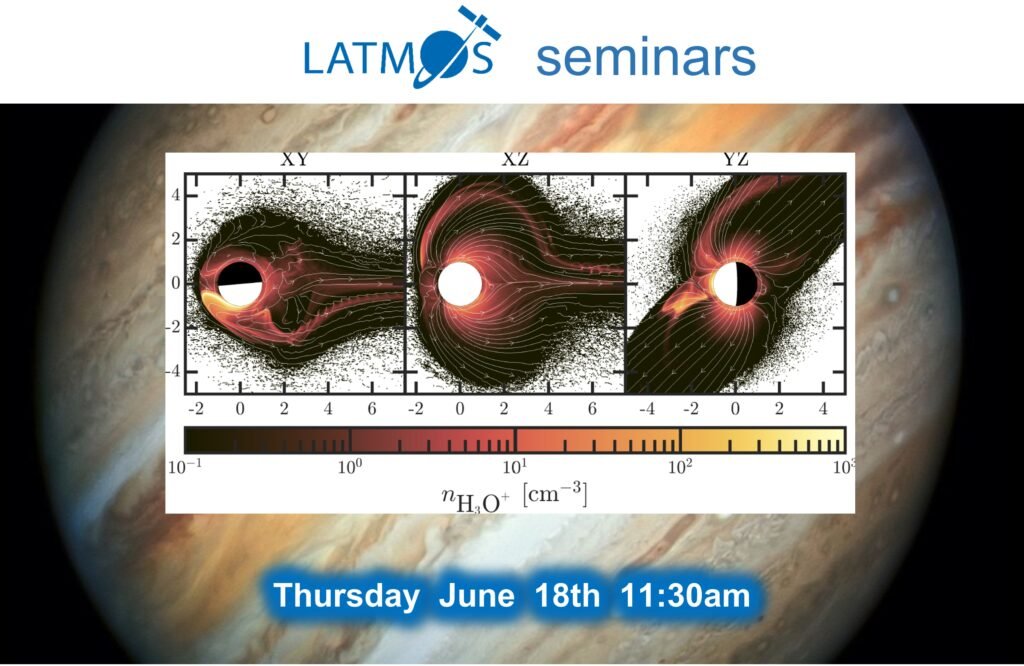
Ganymede is the largest moon of the Solar System. It is the main target of ESA’s Jupiter Icy Moons Explorer, Juice, one of the L-class missions of the Cosmic Vision Program. Juice’s goal is to characterise Ganymede, alongside Callisto and Europa, their exospheres, ionospheres, and interiors, including their subsurface oceans. It is understood that such oceans could offer the best conditions in the Solar System for hosting life outside Earth, or at least for developing the ingredients needed to do so. Such characterisations cannot be performed remotely from Earth and require in situ field and particle measurements by Juice. Ganymede is an airless body: It hosts an exosphere dominated by H2, O2, and H2O. This neutral exosphere is in turn ionised by energetic electrons from the Jovian magnetosphere, which leads to the formation of an ionosphere. However, Ganymede’s ionosphere is poorly constrained and requires modelling to be prepared for Juice’s arrival. Over the past years, it has been shown that its composition was dominated by O2+ and H2+. However, the serendipitous detection of H3+ showed that ion-neutral chemistry occurs and should be included. Ganymede’s ionosphere, in terms of number density and composition, is also not steady and varies with 2 parameters: its location within the Jovian magnetosphere and its local time.
During this presentation, I will first give a brief overview of what we know so far about Ganymede’s exosphere and plasma environment. I will then present recent modelling efforts and results that help to constrain its plasma environment in terms of ion number density, composition, velocity, and ion energy distribution. These results will be placed in the context of the Juice mission and how they can support operations and the interpretation of future plasma measurements.
Previous LATMOS seminars are now available on Youtube:
https://youtube.com/playlist?list=PLVDexVGJCe0duF4LANooppLeGAdmlDRnN&si=mi5wjsxRsKgQQ6iC