
[Séminaire LATMOS] Observations of lunar surface-origin and exospheric ions by the Kaguya Ion Mass Analyzer
3 mars : 11h30 – 13h00
Mardi 3 mars, Kei Masunaga (Yamataga Univ.) donnera un séminaire intitulé « Observations of lunar surface-origin and exospheric ions by the Kaguya Ion Mass Analyzer ». Le séminaire aura lieu à 11h30 au LATMOS à Guyancourt en salle 2202. Il sera retransmis sur Zoom.
On Tuesday March 3th, Kei Masunaga (Yamataga Univ.) will give a seminar on the « Observations of lunar surface-origin and exospheric ions by the Kaguya Ion Mass Analyzer ». The seminar will take place at 11:30am in LATMOS Guyancourt in room 2202. It will be retransmitted on Zoom.
Observations of lunar surface-origin and exospheric ions by the Kaguya Ion Mass Analyzer
Mardi 3 mars 2026
11h30
LATMOS
Salle 2202
11, boulevard d’Alembert
Guyancourt
>>> VISIOCONFERENCE <<<
Le séminaire sera retransmis sur Zoom CNRS.
Contacter audrey.chatain [at] latmos.ipsl.fr pour obtenir le lien.
Abstract:
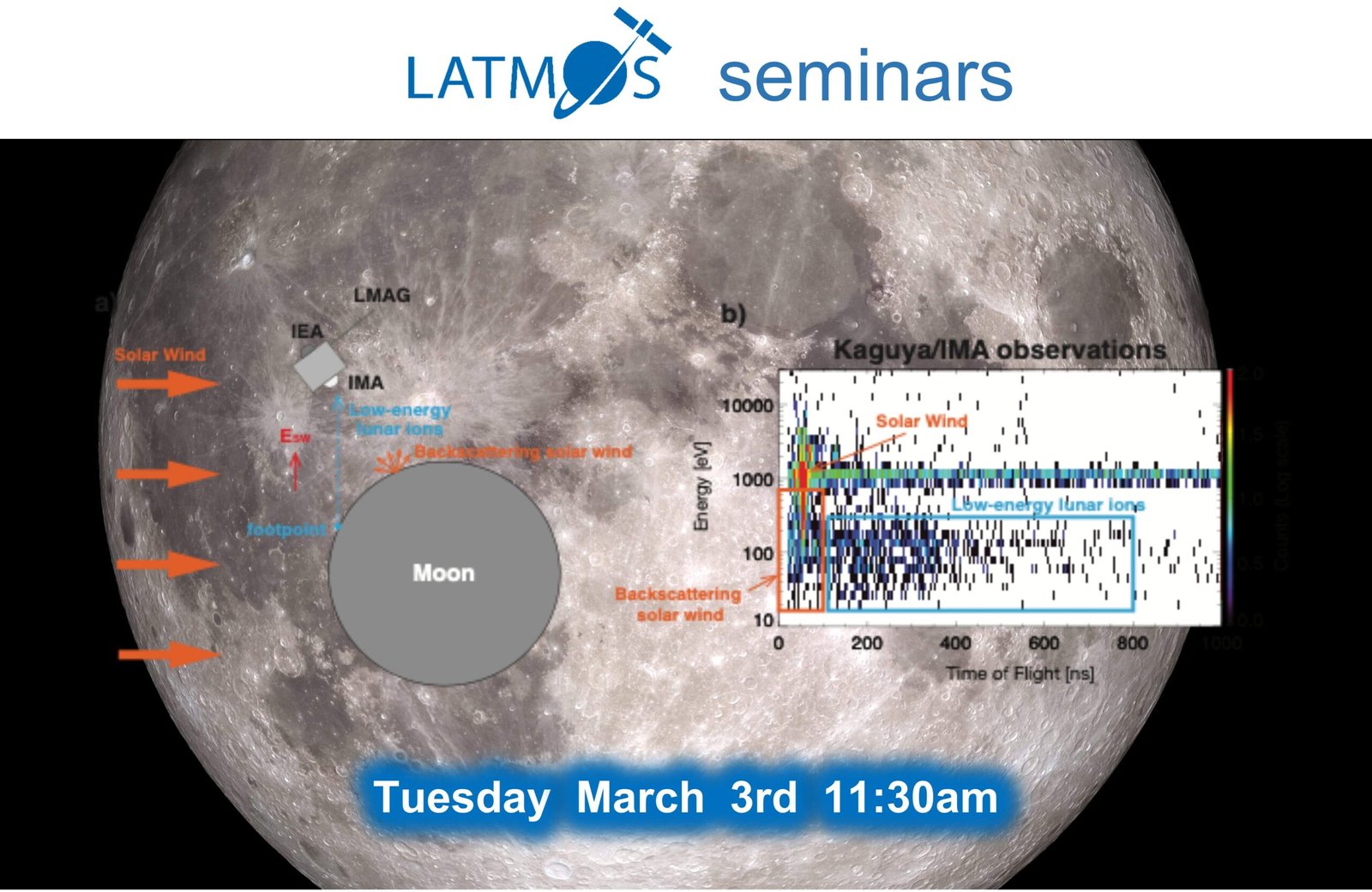
Low-energy ions associated with the lunar surface and exosphere provide valuable information on surface composition and volatile-related processes on airless bodies. In this seminar, I will present an overview of ion observations obtained by the Ion Mass Analyzer (IMA) onboard the Kaguya spacecraft, focusing on the spatial and temporal characteristics of lunar-origin ions.
Using approximately one year of time-of-flight (TOF) data, we examined the distributions of multiple ion species commonly observed in the lunar environment, including He⁺, C⁺, O⁺, Na⁺, Al⁺, K⁺, and Ar⁺, primarily in the low-energy range below 300 eV. Assuming that these ions are accelerated by the motional electric field of the solar wind prior to detection, the observed fluxes were mapped to corresponding regions on the lunar surface. The results reveal systematic asymmetries in ion occurrence, with enhanced fluxes on the dawnside compared to the duskside.
In addition to major atomic ions, the TOF spectra occasionally exhibit residual signals at mass-to-charge ratios consistent with water-related ion species. These signals show a tendency to be more frequently observed at high latitudes than at low latitudes, qualitatively consistent with previously reported distributions of lunar water inferred from remote sensing observations. These observations suggest that ion measurements can offer complementary information on the presence and activity of lunar water.
Overall, this seminar shows how ion observations by Kaguya/IMA provide information on various lunar-origin ion species, including water-related ions, and how these results are relevant to future ion measurements, including the Martian Moons Exprolation mission.
Previous LATMOS seminars are now available on Youtube:
https://youtube.com/playlist?list=PLVDexVGJCe0duF4LANooppLeGAdmlDRnN&si=mi5wjsxRsKgQQ6iC