
Le Bootcamp « Intelligence artificielle et observation satellitaire » est une école d’été organisée depuis 2025 au mois d’avril. Il s’agit d’une petite semaine intensive dédiée aux méthodes d’apprentissage automatique (IA) et à leurs applications dans le domaine de la télédétection spatiale.
The « Artificial Intelligence and Satellite Observation » Bootcamp is a summer school that has been held every April since 2025. It is an intensive one-week program dedicated to machine learning methods (AI) and their applications in the field of space remote sensing.
Avril 2025
Rétrospective de la 1re édition (FR/EN)

Avril 2026
Rétrospective de la 2e édition (FR)
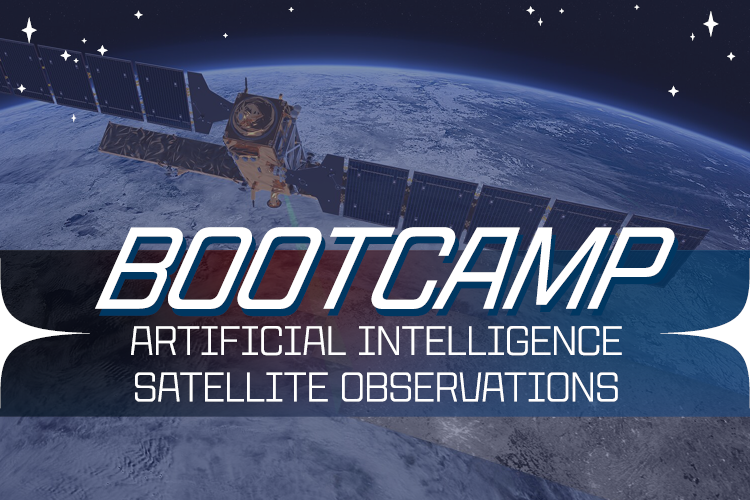
Ce module de formation innovant offre aux étudiantes et étudiants de Master et Doctorat un cadre privilégié d’échanges directs avec des spécialistes, renforçant leur compréhension des enjeux actuels et futurs de l’intelligence artificielle appliquée à l’observation spatiale. L’objectif principal était de permettre aux participant·es de découvrir, comprendre et expérimenter les techniques d’intelligence artificielle appliquées à l’analyse de données issues de l’observation satellitaire de la Terre.
Cet évènement est organisé par l’Académie Spatiale, en collaboration avec le Sorbonne Center for Artificial Intelligence (SCAI) et l’IPSL-CGS.
This innovative training module offers master’s and doctoral students a unique opportunity for direct interaction with experts, strengthening their understanding of current and future challenges in the application of artificial intelligence to space observation. The main objective was to enable participants to discover, understand, and experiment with artificial intelligence techniques applied to the analysis of data from Earth observation satellites.
This event is organized by the Space Academy, in collaboration with the Sorbonne Center for Artificial Intelligence (SCAI) and IPSL-CGS.


Ce travail est porté par la « Climate Graduate School » de l’Institut Pierre-Simon Laplace (IPSL-CGS), soutenue par l’Agence Nationale de la Recherche (ANR) dans le cadre du programme Investissements d’Avenir « Ecoles Universitaires de Recherche » sous la référence n° ANR-11-IDEX-0004 – 17-EURE-0006
This work is led by the “Climate Graduate School” at the Institut Pierre-Simon Laplace (IPSL-CGS), supported by the French National Research Agency (ANR) as part of the “University Research Schools” program under the “Investissements d’Avenir” initiative, grant number ANR-11-IDEX-0004 – 17-EURE-0006
